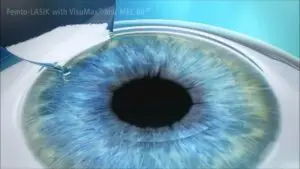
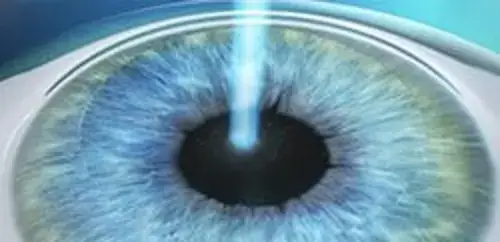
The Trans-PKR, sometimes called PKR all laser, is a technique of Surface laser surgery close to the classic PKR method. The main difference concerns the removal of the epithelium: in Trans-PKR, this step is performed using the excimer laser, without any prior mechanical removal.
Trans-PKR or PKR: what is the same?
In both techniques, refractive correction is performed on the surface of the cornea, without creating a flap.
After the treatment, the epithelium must regrow. A patch lens is usually used during this phase.
What changes with the Trans-PKR?
The laser successively performs the ablation of the epithelium and then the refractive remodeling.
This approach reduces surface instrumental manipulations, the treated surface, and allows automated processing in a sequence.
Does the Trans-PKR hurt less?
Postoperative discomfort remains largely related to the epithelial regrowth. Therefore, as with PKR, there are some days during which burns, tearing or photophobia may be present.
The exact experience varies from patient to patient.
What a comeback after a Trans-PKR?
Some Trans-PKR strategies can promote effective reepithelialization, but faster recovery should not be presented as a universal guarantee.
In both cases, recovery usually remains more gradual than after an injury. LASIK.
For which patients can this superficial laser surgery be considered?
The Trans-PKR can be proposed in certain myopes, astigmatism or hypermetropias depending on the possibilities of the laser and the corneal assessment.
It can also be discussed when a surgery without a flap is desired.
How to choose between PKR and Trans-PKR?
To remember
Trans-PKR is a technical evolution of the surface PKR. It automates the removal of the epithelium, but retains the fundamental principle and the healing phase specific to PKR.