The lenticule donation after SMILE opens the possibility of reusing a corneal tissue removed during surgery. This reuse of the lenticule can be part of certain corneal surgery projects in connection with an eye bank, particularly within the framework of hospital collaborations.
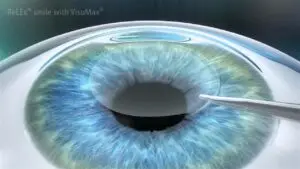
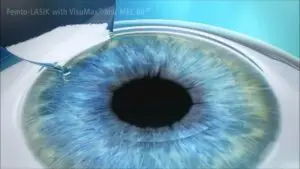
During a SMILE surgery, the laser creates a small disc of tissue called lenticule, This is removed to modify the optical power of the eye.
Usually, this tissue is no longer useful. However, in certain regulated fields, it can be preserved for corneal therapeutic applications.
What is a SMILE lenticule?
The lenticule is a thin portion of corneal stroma created by the femtosecond laser.
Its shape and thickness correspond to the planned refractive correction.
Why might it be interesting for other patients?
Corneal tissue possesses optical and biomechanical properties that can be useful in certain corneal surgery techniques.
Research and several hospital teams have been working for several years on different forms of lens implantation or transplantation.
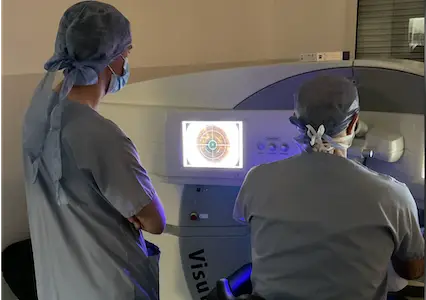
How does the procedure work at the Laser Expert Vision Center?
The project is being carried out in collaboration with the teams at Rouen University Hospital and the eye bank.
When a patient meets the specified conditions and accepts the donation, the lenticule can be stored in accordance with the applicable preservation and traceability protocol.
Is this equivalent to a conventional cornea donation?
No. The lenticule represents a specific portion of the corneal stromal tissue. It does not automatically replace a complete cornea and its indications depend on the pathology and the technique used by the receiving team.
Why is this approach special?
It gives a second potential use to a tissue removed during refractive surgery.
The project thus links refractive surgery, tissue banking and corneal reconstructive surgery.
A collaboration born of the exchange between surgeons
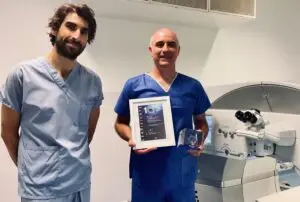
The project of Dr. Thierry Lebrun with Dr. Muraine and the teams of the Rouen University Hospital, via The French Eye Bank illustrates how an innovation can arise from the sharing of experience between liberal medicine and a university hospital.
To remember
The lenticule transplant after SMILE does not change the main objective of the procedure, which remains the visual correction of the patient undergoing surgery. However, it opens up an additional possibility: to valorize corneal tissue that would otherwise be removed.